
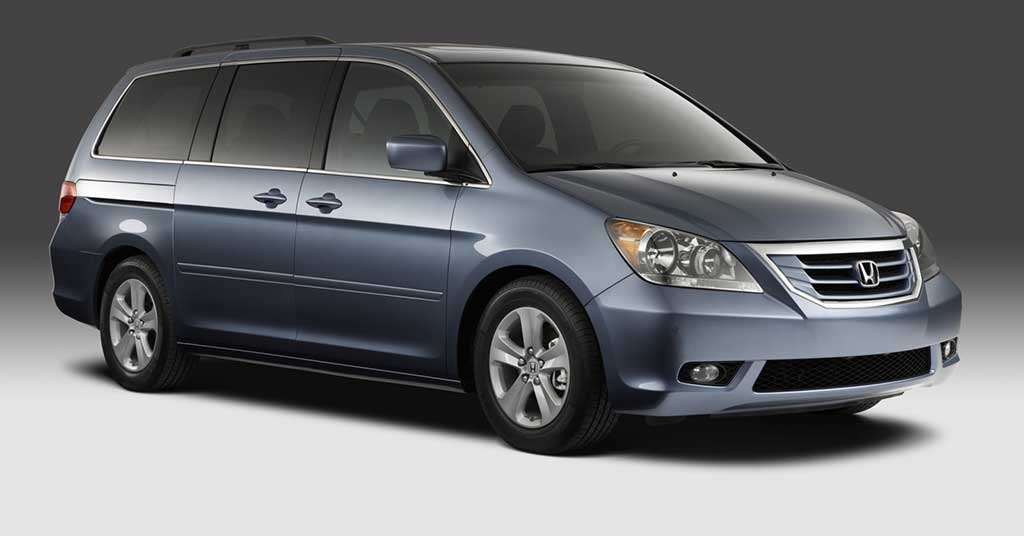
Once a popular family minivan, the 2010 Odyssey now demands careful inspection before that bargain price makes sense

On paper, a used 2010 Honda Odyssey minivan looks like a bargain family hauler. In reality, its long-term reliability issues mean the low price you can find them for today often comes with real costs for owners.
First introduced in North America in 1999, the Odyssey’s basic layout and mechanical approach were already well established by 2010, with Honda refining a design that prioritized space and power over long-term durability.
Minivans exist to move people and cargo efficiently. For many Canadian families over much of the past two decades, they made more sense than SUVs because nothing else offered the same mix of space, sliding doors and day-to-day usefulness.
All 2010 Odyssey uses a 3.5-litre V6 producing 244 horsepower, paired with a five-speed automatic transmission. Power was a strong point when new and still is. Even fully loaded, the Odyssey pulls confidently and cruises easily on the highway.
Honda’s Variable Cylinder Management system was standard, shutting down cylinders during light-load driving to improve fuel economy. Over time, this system has become one of the model’s biggest liabilities. Today, high oil consumption is common in higher-mileage vans, often requiring owners to add oil between regular oil changes. Many owners check oil at every fill-up. In some cases, vans whose owners did not regularly check the engine oil level and top it up between oil changes have suffered serious engine damage.
Fuel economy was rated at 12.3 L/100 km city and 7.8 highway when new. Today, expect worse numbers, especially in city driving, as engines and transmissions age.
Space remains the Odyssey’s strongest asset. Seating for eight is standard, the third-row seat folds flat into the floor, and with seats removed or stowed, cargo capacity reaches 4,173 litres. Even now, it hauls people and gear better than most midsize SUVs.
The second-row seats are heavy and awkward to remove. Owners complained about this when the van was new, and nothing has changed. Most people leave them in place.
Trim levels ranged from the basic DX, which skips features such as power sliding doors, to the fully loaded Touring. Upper trims add tri-zone climate control, leather seating, a power liftgate, heated front seats, rear DVD entertainment and navigation. Today, the tech feels old and can be glitchy, but the comfort features still matter.
The 2010 Odyssey also shows its age in terms of noise and refinement. Even when new, it was noisy. Road and tire noise are constant, especially on the highway. Rivals such as the Hyundai Entourage and Kia Sedona were noticeably quieter. Honda fixed much of this for 2011, but the 2010 model missed out.
Today, many 2010 Honda Odyssey minivans need suspension work, including bushings, sway-bar links, struts, wheel bearings and steering components. Power steering pump failures are common. The five-speed automatic can last, but only if the fluid was changed regularly. Vans that skipped service often develop rough shifts or torque converter shudder.
Brake wear is another common complaint. Pads wear quickly, rotors warp and grinding noises are frequent, partly because of the Odyssey’s weight and partly because the original parts installed by Honda when the vehicle was built were never great.
Electrical and convenience systems also age poorly. Climate control actuators, blower motors, power sliding doors and liftgate hardware are all known trouble spots on higher-kilometre vans, often those with more than 200,000 kilometres.
Rust is not widespread, but should be checked carefully around wheel arches, rocker panels and door bottoms, especially on vans that lived through salted winters.
When new, Consumer Reports rated the 2010 Odyssey as slightly below segment norms for reliability. J.D. Power was more critical, flagging predicted reliability concerns despite strong comfort and performance scores. Time has largely backed up both views.
Today, many 2010 Odysseys have well over 200,000 kilometres. High-kilometre or rough-looking vans often sell for $3,000 to $6,000. Clean, well-maintained examples with service records usually land between $6,000 and $9,000. Exceptionally clean, low-kilometre Touring models can still reach the low-to-mid-$10,000 range, but those are increasingly rare. Condition and maintenance matter far more than trim level.
Comparable 2010 alternatives commonly found in Canada include the Toyota Sienna and Kia Sedona. Newer family vans such as the Kia Carnival or hybrid versions of the Sienna offer more refinement and better fuel economy, but they cost far more.
Our verdict
The 2010 Honda Odyssey can still work as a used family vehicle, but only if buyers know what they’re getting into. It still offers a lot of space, flexible seating and strong V6 power for the money. The downside is ownership risk. High oil consumption, aging parts and rising repair costs are common on higher-kilometre vans. Buyers who inspect carefully, plan for repairs and understand why these Odysseys are cheap today may find value. Anyone looking for an easy, low-maintenance family vehicle should look elsewhere.
| Auto Desk
Explore more on 2010 car review, Honda
The views, opinions, and positions expressed by our columnists and contributors are solely their own and do not necessarily reflect those of our publication.
Troy Media empowers Canadian community news outlets by providing independent, insightful analysis and commentary. Our mission is to support local media in helping Canadians stay informed and engaged by delivering reliable content that strengthens community connections and deepens understanding across the country.

