
Governments are negotiating Indigenous land agreements that critics warn could reshape ownership, taxation and development across Vancouver

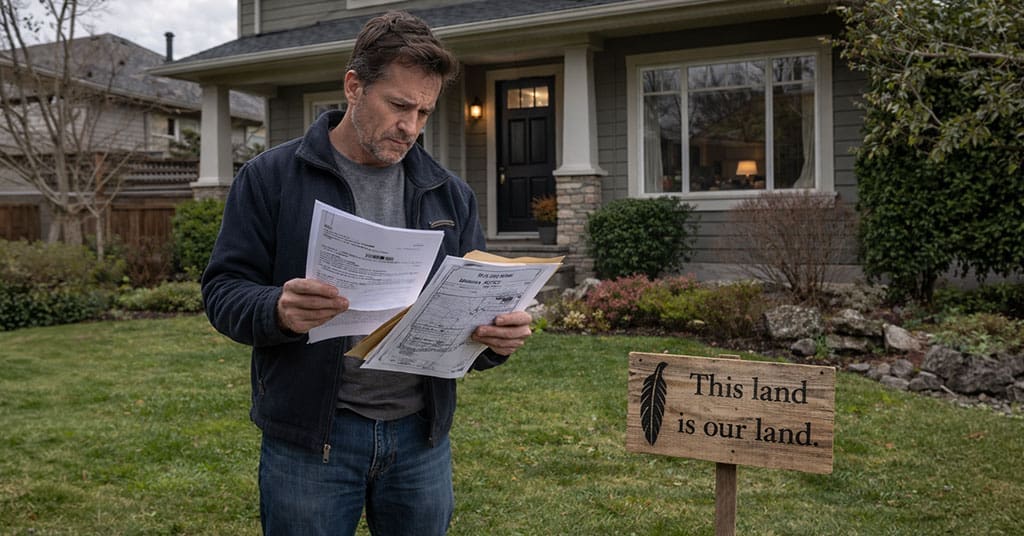
BC residents, still reeling from the fallout of the Cowichan decision, in which a B.C. court allowed Aboriginal title claims over lands on Vancouver Island to proceed, recently woke to newspaper reports about an agreement between the federal government and the Musqueam Indian Band relating to Aboriginal Title claims over large parts of the Metro Vancouver region and raising questions about the future of property rights and development authority in the city. Politicians quickly attempted to reassure the public that the agreement did not mean what it appeared to say.
Those reassurances rang hollow almost immediately. Another First Nation, the Squamish, quickly signalled that it would dispute the Musqueam claim. Other disputes between Indigenous groups are almost certain to follow, because this agreement is only one of many agreements now being negotiated behind closed doors in Ottawa and Victoria.
Governments justify these agreements by arguing that British Columbia never concluded treaties with most of the Indigenous peoples who lived there after Confederation. Because of that historical failure, they say, governments today must negotiate modern agreements to correct the omission.
Even if one accepts that argument, however, these modern agreements bear little resemblance to the numbered treaties signed between 1871 and 1920. Those treaties required Indigenous peoples to surrender any claims they had to land in exchange for compensation and certain guarantees from the Crown. The arrangements now being negotiated in British Columbia operate very differently.
Under the numbered treaties, compensation was modest. Indigenous signatories received reserves, the right to hunt on surrounding Crown land until it was needed for settlement and annuities of five dollars per year. The arrangement was designed to bring Indigenous communities gradually into the Canadian economic system.
Today’s agreements involve something entirely different. Indigenous signatories may retain any Aboriginal Title claims they may have, even after signing. They receive substantial financial compensation and, in many cases, effective authority over large areas of Crown land. That authority can in practice operate as a veto over development.
Governments defend these arrangements in another way as well. They argue that such agreements are required by the Constitution. Section 35 of the Constitution Act, 1982 recognizes and affirms existing Aboriginal and treaty rights, and many officials claim that modern agreements are necessary to satisfy those constitutional obligations.
Critics, however, note that Indigenous peoples already possess the same civil and political rights as every other Canadian. They vote, run for office and hold passports like any other citizen. In addition, they possess a range of legal privileges that other Canadians do not enjoy. The only right they do not have is the ability to own private property on reserve land, a restriction that exists within the reserve system itself.
The deeper issue, however, lies in how courts have interpreted Indigenous rights and title. For most of Canada’s history, the assumption was that Indigenous societies were hunting cultures that occupied territory but did not hold land in the European legal sense of permanent title. Territories shifted over time as groups competed for resources. The modern legal concept of Aboriginal Title was therefore largely absent from earlier Canadian law.
That changed in the late twentieth century, when the Supreme Court of Canada began to reinterpret Indigenous rights under Section 35 of the Constitution Act, 1982. The turning point was the 1997 Delgamuukw decision, in which the Supreme Court of Canada confirmed that Aboriginal title exists in Canadian law and recognized Aboriginal Title as a powerful legal concept that opened the door to far-reaching claims over land and resources.
Subsequent rulings expanded this framework. Courts recognized a “duty to consult” Indigenous communities before development projects could proceed on lands subject to potential claims. In practice, these rulings created a system in which governments are often required to consult and negotiate with Indigenous groups over land use and development.
The Cowichan decision illustrates how this legal framework continues to evolve. It forms part of a growing line of court rulings recognizing Aboriginal title and expanding legal obligations on governments dealing with Indigenous land claims. Faced with stronger legal claims and the growing risk of losing costly court battles, governments increasingly choose to negotiate agreements rather than litigate title disputes to their conclusion.
These developments carry significant implications. If Aboriginal Title claims extend over large urban areas, property owners may face new layers of uncertainty. Questions arise about whether homeowners or developers will need to obtain approval from Indigenous authorities for building permits, property transfers or development projects. Governments have offered few clear answers.
The consequences may extend well beyond British Columbia. Leaders in the numbered treaty provinces have watched developments in B.C. with interest. Many are now asking why similar arrangements should not apply in their regions as well. Concepts such as co-ownership of land and Indigenous consent over development are already being discussed.
If these trends continue, the legal structure of property ownership across Canada could change dramatically. The certainty of title, the foundation of modern property systems, may become increasingly uncertain.
Supporters of these legal developments and modern agreements argue that such changes are necessary to achieve reconciliation. Critics counter that they represent a fundamental shift away from the principle of equal citizenship under the law.
Canada’s Founders envisioned a country in which people of different backgrounds would gradually integrate into a common civic identity. Indigenous communities were given reserves and certain protections, but the long-term expectation was that all citizens would participate in the same economic and political institutions.
Over time, however, that vision has been replaced by a model that treats Indigenous communities as distinct political entities with separate authority. The result is a complex system of overlapping jurisdictions and claims.
Many scholars have criticized this development. Professor Bruce Pardy has documented how a series of Supreme Court decisions has steadily expanded Indigenous claims and obligations on governments. Other analysts warn that the cumulative effect may be to destabilize property rights and economic development.
If courts and governments continue along this path, conflicts over land and jurisdiction are likely to multiply. Some observers argue that only constitutional negotiations can fundamentally revisit the legal framework now governing Indigenous rights and title.
Professor Bruce Pardy has suggested that the proposed Alberta sovereignty referendum could create such an opportunity. A strong “Yes” vote might force governments across Canada to reopen constitutional discussions on a range of issues, including Indigenous governance, equalization, immigration policy and energy development.
Under that scenario, Albertans could support sovereignty as a strategic measure to compel negotiations, while reserving the option to reject actual separation after discussions conclude.
Whether or not that strategy gains traction remains to be seen. What is clear, however, is that Canada now faces a fundamental debate about its constitutional structure and the principles that should govern relations between citizens and governments.
If the country is to remain stable and prosperous, Canadians must eventually decide whether their political system should rest on the principle of equal citizenship under a single national framework or on a system of overlapping jurisdictions rooted in historic identities.
That question will shape the future of property rights, governance and national unity for decades to come.
Brian Giesbrecht is a retired judge and a senior fellow at the Frontier Centre for Public Policy.
Explore more on Aboriginal land claims, Property rights, Aboriginal Politics
The views, opinions, and positions expressed by our columnists and contributors are solely their own and do not necessarily reflect those of our publication.
Troy Media empowers Canadian community news outlets by providing independent, insightful analysis and commentary. Our mission is to support local media in helping Canadians stay informed and engaged by delivering reliable content that strengthens community connections and deepens understanding across the country.

