
McLuhan was right: media environments now shape thought, education and public behaviour more powerfully than content itself
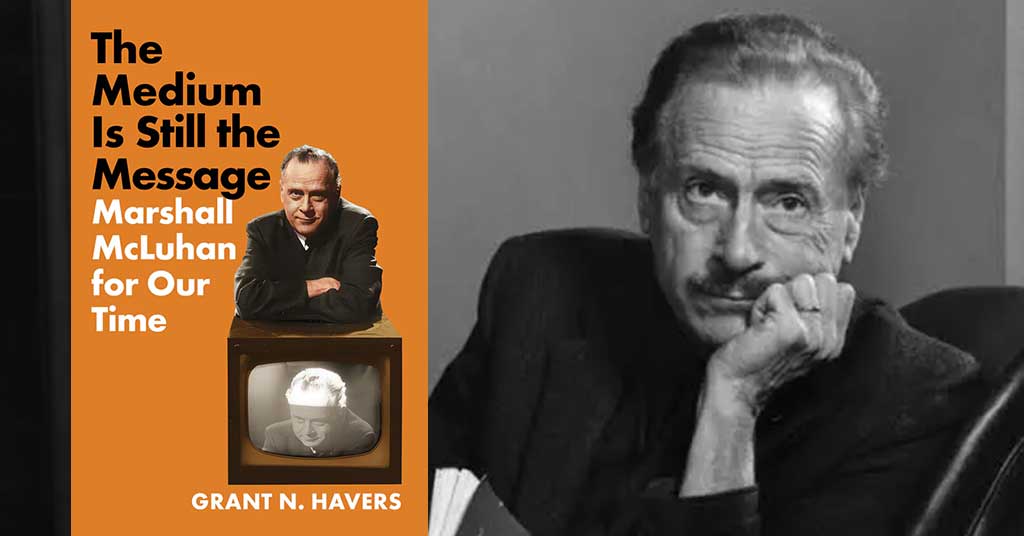
Title: The Medium is Still the Message: Marshall McLuhan For Our TimeAuthor: Grant Havers
Publisher: Northern Illinois University Press
Publication Year: 2025
(Available from Amazon)

Long before social media and smartphones, Marshall McLuhan warned that media technologies create environments that alter how people think and behave. Grant Havers’ The Medium is Still the Message: Marshall McLuhan For Our Time shows how right McLuhan was and why that insight now carries consequences we can no longer ignore.
Havers’ book is not a fashionable rediscovery or a retrospective tribute. It is the result of more than 30 years of sustained reading and reflection on McLuhan’s work, written by an author who understands both its intellectual depth and its contemporary urgency. At its core is McLuhan’s most unsettling claim. The media do not merely transmit information. They shape the conditions under which information is received, interpreted, and acted upon.
McLuhan, a Canadian scholar who taught at the University of Toronto and rose to international prominence in the 1960s, argued that media-created environments influence human perception before conscious judgment begins. People adapt to these environments long before they recognize what is happening.
That insight made him one of the most influential media thinkers of the 20th century. Scholars such as Walter Ong, Harold Innis, and Eric Havelock were equally rigorous analysts, but their work remained largely confined to academic circles. McLuhan entered public consciousness because he described changes people were already living through.
Most discussions of media focus on content—news, entertainment, commentary. Even the word “media” suggests mediation, a channel through which information flows between people. McLuhan asked a more basic question: What kind of environment does a medium create? What habits of attention does it reward? What forms of thinking does it encourage, and which does it quietly undermine?
Modern people pride themselves on being informed. Keeping up with the news is treated as both a civic duty and a personal virtue. Hegel once remarked that reading the morning newspaper was the modern realist’s daily benediction, a view later endorsed by Nietzsche. The implication was that modern media had replaced older sources of authority. Journalists were not priests, and the news no longer mediated between the human and the divine.
That confidence was shaken when Aleksandr Solzhenitsyn told Harvard graduates in 1978 that they had a right not to know, meaning a right not to have their minds and souls filled with trivia and moral debris. McLuhan pressed the point further. The deeper danger, he argued, was not misinformation but invisibility. Media environments shape habits of thought before judgment even begins. That is why their influence is so difficult to recognize and resist.
This is the insight Havers brings back into focus. McLuhan’s most famous formulation, The Medium is the Message, has not lost its force. The medium does not erase content, but it places limits on how that content can be understood. Form shapes perception first. Meaning follows.
Critics often respond by claiming that technology is neutral and can be used for good or bad purposes. McLuhan rejected this, as did his contemporaries George Grant and Jacques Ellul. Technology is its use. It is designed with particular ends in mind and produces predictable effects. Misuse is possible, but dependency is rarely accidental.
TikTok does not need to intend addiction for addiction to occur. The medium rewards compulsive engagement regardless of content. Smiling pets and dancing teenagers are incidental. Dependency is the result.
McLuhan’s writing style often irritates modern readers. He preferred exaggeration to caution and aphorism to systematic argument. Yet the substance of his claims has aged well. A print environment fostered privacy, deliberation, and sustained debate. The digital world is different. It is public, immediate, and oriented toward constant exposure.
By print culture, McLuhan meant a world shaped primarily by books and newspapers, media that reward linear thought, sustained attention, and private judgment. Digital platforms are structured differently. They prioritize speed, visibility, and continuous response.
The political consequences are now hard to miss. Tribal unanimity often replaces debate, and public life rewards performance over persuasion. That shift helps explain why contemporary politics feel more acrimonious and less rational than those shaped by a print environment.
McLuhan also insisted that new media could make older media obsolete without making them irrelevant. He wrote books, as does Havers. That fact alone suggests that resistance remains possible, though it requires effort and attention.
Social media offer the clearest contemporary illustration. They provide lonely individuals with a sense of belonging and encourage identity formation through public display. This imaginative membership postpones engagement with reality. It often deepens anxiety rather than relieving it.
Havers grounds this analysis in lived experience, particularly in education. Teaching political science at the University of Calgary, he observed how laptops transformed student behaviour. Cursive note-taking disappeared. Handwritten exams became unreadable. Students typed verbatim transcripts rather than summaries. The ability to distinguish central arguments from peripheral detail declined. Research confirms that longhand note-taking improves comprehension in ways transcription does not.
Instructors adapted by replacing in-class exams with take-home assignments. New evaluation methods followed, along with new strategies to prevent cheating. Artificial intelligence has only intensified these pressures.
Smartphones introduced another layer of dependency. When students were asked to abstain from social media for a week, many reported noticing the physical world for the first time. Some recognized their own dependence. One First Nations student remarked that she had seen enough addiction in her family to recognize it when she saw it.
These observations return us to McLuhan’s central discovery. New media create environments with consequences that are often unanticipated and rarely visible. Understanding those consequences is the first step toward resisting them.
Havers describes McLuhan as a conservative, not in a partisan sense, but in his rejection of technological inevitability. Unlike Grant, McLuhan denied that technology was fate. His analogy was blunt. The electric environment is cannibalistic, and survival requires studying cannibals.
One of McLuhan’s most unsettling insights was that human creations reveal human purposes. Technologies express what we value. To understand the producer, study the product.
University branding offers a mundane illustration. Slogans urge students to “start something,” “disrupt,” or “invent.” None urges them to study. When business logic colonizes education, universities become extensions of the economy. The dissolution of classics and religious studies, justified by administrative language about “reimagining disciplines,” reflects this confusion of education with training.
Ironically, some business leaders now acknowledge the loss. Executives at BlackRock and Goldman Sachs have publicly recognized the value of liberal arts graduates. Yet even they misunderstand liberal education, which exists for its own sake, not as a tool for improving productivity.
McLuhan’s idea of the global village offers a final example. Electronic interdependence makes everyone involved in everyone else’s affairs. During COVID-19, Albertans reported neighbours for suspected violations in numbers that exceeded confirmed infections. Many felt morally obligated to do so. It was not their finest hour.
Havers’ book does not trade in nostalgia. It trades in clarity. For readers willing to examine the environment they inhabit, The Medium is Still the Message offers a rigorous and timely guide. McLuhan’s warnings were never meant to inspire fear. They were meant to provoke awareness. That remains the necessary starting point for resistance.
Our Verdict
Grant Havers’ The Medium is Still the Message deserves to be read because it explains what many people intuitively feel but cannot easily articulate. Modern media are reshaping how we think, learn, and relate to one another in largely invisible ways. Havers delivers intellectual rigour without academic clutter and makes a persuasive case that understanding media environments is essential if we are to remain intellectually independent.
Barry Cooper is a professor of political science at the University of Calgary. Author of 35 books and 200 studies, his book on terrorism was recovered by Seal Team Six during their visit to the Osama bin Laden compound in Abbottabad in May 2011. This commentary was submitted by the Frontier Centre for Public Policy,
Explore more on Social Media, News media, Non-fiction books
The views, opinions, and positions expressed by our columnists and contributors are solely their own and do not necessarily reflect those of our publication.
Troy Media empowers Canadian community news outlets by providing independent, insightful analysis and commentary. Our mission is to support local media in helping Canadians stay informed and engaged by delivering reliable content that strengthens community connections and deepens understanding across the country.

